Design notes · 28 July 2026 · 6 min read
Designing for a hill site: what the slope decides before you do
On a Himachal plot, the contour, the drainage line, and the winter sun angle fix most of your plan before the first sketch. Here is how we read a site.
Most clients arrive with a plan in mind and a plot they have already bought. The plan is usually drawn for flat ground. In the hills, that is the first thing that has to go.
A sloping site is not an obstacle to design around — it is the strongest piece of information you have. Before we draw anything, we walk the plot at least twice: once in the morning and once late in the afternoon, so we can see where the light lands and where the shadow of the ridge falls.
What we look for on a first visit
- The direction and grade of the slope, which decides whether the house steps down, cuts in, or cantilevers out.
- Where water already runs during monsoon — you cannot argue with a drainage line, only plan for it.
- The winter sun path, because a room that is beautiful in June can be unusable in January.
- Approach and parking level, which on a steep plot often dictates which floor becomes the entrance floor.
- Existing trees worth keeping, and the neighbours' windows worth not looking into.
Stepping instead of levelling
The cheapest-looking option on a slope is to cut a flat pad and build a box on it. It is rarely the cheapest in practice: you pay for retaining walls, you lose the view from the lower rooms, and you end up with a plinth that looks like an afterthought.
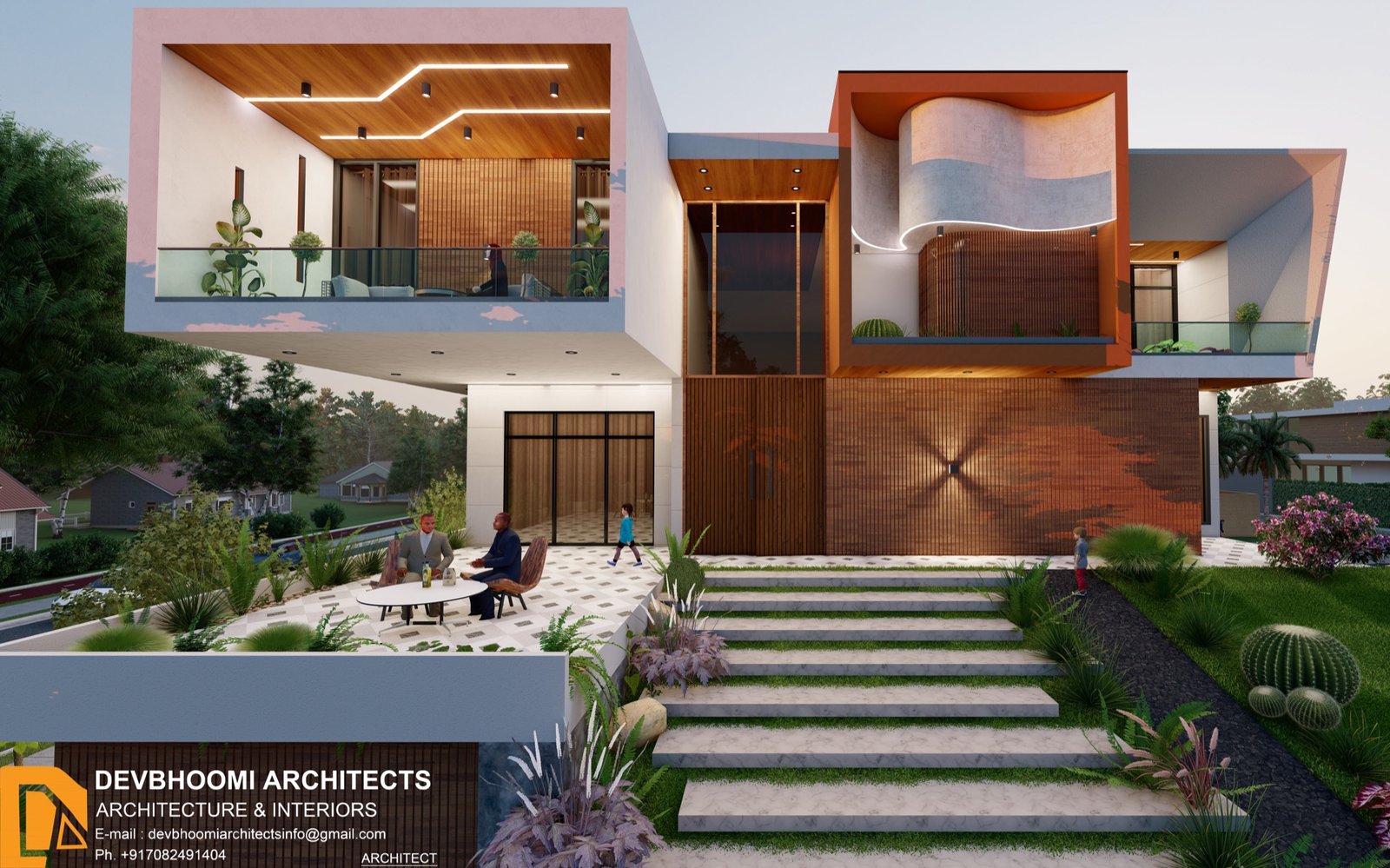
Stepping the house with the contour costs more in drawing time and less in earthwork. It also gives you something you cannot buy later — every level gets its own terrace, and the roof of one wing becomes the garden of the next.
Our work begins with the mountain, not against it.
Detail for weather, not for photographs
Hill weather finds every shortcut. Overhangs need to be deep enough to keep driving rain off the wall, not just wide enough to read well in a render. Parapets need drips. Terraces need slope and a second layer of waterproofing at the junctions. Stone looks best when it is laid with a real bed, not stuck onto a wall as cladding.
None of this is glamorous, and all of it is what decides whether the house still looks well cared for in ten monsoons.